
Customer Story
GSS & GMS Climbed Every Roof to Earn Customer Trust. Scanifly Helped Them Keep That Promise, While Improving Safety.

Results From Using Scanifly
Meet Granite State Solar & Green Mountain Solar
Most solar companies pick a state and plant a flag. Granite State Solar (GSS) and Green Mountain Solar (GMS) took a different approach.
Founded and grown from the ground up in New Hampshire and Vermont respectively, the two brands share a single team, a single mission, and a single set of values, while keeping the kind of local identity that actually means something to homeowners in these states. “Granite State Solar in New Hampshire just makes sense. Green Mountain Solar in Vermont just makes sense,” says Eric Kilens, Sales Manager for both brands. “By the time we thought about consolidating, those names had become too strong to give up.”
The company built its reputation over more than a decade by doing something rare in residential solar: going on-site before making promises. While competitors were running remote designs off outdated satellite imagery, Granite State Solar and Green Mountain Solar were sending salespeople to customers’ homes, getting on roofs, taking real measurements, and designing systems based on actual data.
It was the right approach, but over time, the weight of it started to show.
The Challenge: Quality Had a Cost
For years, the company’s differentiator was simple: honest, accurate proposals. In rural New Hampshire and Vermont, satellite imagery is notoriously unreliable. Tree canopies change. Images go stale. If you design a system based on a top-down photo taken two years ago, you’re designing based purely on a guess.
“We would never want a customer to spend $30,000 or $40,000 on something we didn’t know for sure was going to work for them,” Kilens explains. “We wanted to give accurate numbers because we genuinely cared.”
So salespeople climbed roofs. Every home. Every visit. In every season.
They carried ladders, tape measures, and clipboards. Most reps also had Solar Pathfinders initially, and then switched over to the Solmetric SunEye. They measured roof pitches by hand and calculated obstruction distances using Pythagoras’ theorem when sections of the roof were too steep or slippery to access directly. In New Hampshire and Vermont, that meant battling frost, heavy dew, and snow for much of the year.
With three salespeople per state, the team was collectively accessing 15 to 20 rooftops per day. “Knock on wood, we never had a serious incident,” Kilens says. “But we had close calls. And at some point, we had to acknowledge that there had to be something better out there.”
Beyond safety, the manual process had an accuracy ceiling. When a roof was inaccessible or measurements were taken from the ground, errors crept in. The most painful version of that error showed up on install day. A site plan called for 30 panels, and the installer arrived to find that only 27 would physically fit. The customer had to be told on the spot that their system was smaller than what they’d been sold.
“Nobody likes surprises,” Kilens says. “And nobody likes a change order the day of installation when they think they’re getting one thing and they’re getting another.”
The Solution: Sell with Onsite Data, Without the Roof Climbs
Drone Flights Replace Roof Climbs
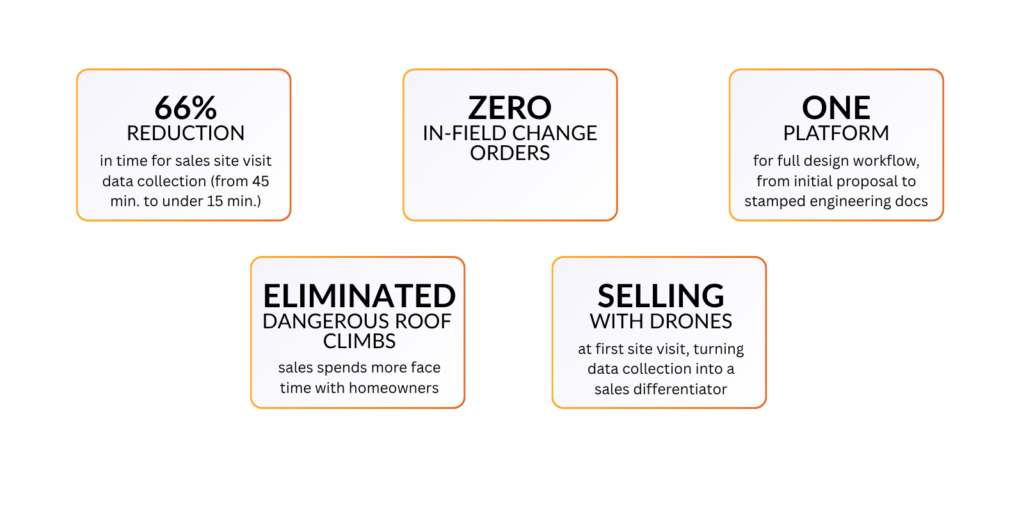
Today, a GSS or GMS salesperson arrives at a home and launches a drone. The flight takes 10 to 15 minutes and captures complete data across every roof plane: measurements, obstructions, and whole roof and per panel solar shade readings.
Before, roughly half of a site visit was consumed by roof access and manual measurements. Now that time goes back to the homeowner. Salespeople are having more conversations, answering more questions, and spending less mental energy on whether they measured the right ridge correctly.
“The salespeople aren’t getting sweaty and dirty on the roof in the summer, and they’re not freezing on a rooftop in January,” Kilens says. “They are really enjoying that aspect of it.”
Panel-Level Accuracy That Ends Change Orders
Scanifly’s 3D models are accurate to within one to two inches. That level of precision has effectively eliminated the design-to-install discrepancies that used to create last-minute change orders. In two years of using Scanifly, the company has seen virtually zero cases of the proposed system losing panels on install day because they didn’t fit.
When technicians show up to a job now, the site plan matches reality. The customer already knows where the conduit runs, where the panels go, and what to expect when their system gets energized. Installing exactly what was sold builds the trust that’s at the heart of Green Mountain Solar and Granite State Solar’s reputation.
3D Visualizations as a Selling Tool
One of the unexpected wins has been how Scanifly’s models changed the way salespeople communicate with homeowners, not just during the initial visit, but well after.
The team now schedules follow-up Zoom calls where they share their screen and walk customers through the design in Scanifly. They can show panel-level shading analysis with Scanifly’s proprietary Viewshed technology: why certain panels were placed where they were, which roof planes get the most sun, where shade from a nearby tree is actually affecting production. If a customer asks why the panels aren’t on a particular section of the roof, the salesperson can move them there in real time and show what happens to production.
“It helps answer a lot of questions homeowners might have and gets them closer to a decision,” Kilens says. “Once they can see it, their actual house and their actual array, they’re one step closer to wanting it.”
The team also sends customers a share link with a 3D animation of their design and a sun path simulation. It’s become a standard part of every proposal.
One Platform, Pre-Sale to PTO
In the last six months, the back-office transformation has been just as significant as what’s happening in the field. The company has fully consolidated their post-sale workflow into Scanifly: plan sets, one-lines, and stamped engineering reports, all through one platform.
Before, those pieces were scattered. A design tool here, a custom one-line from the electrician there, a third-party engineering stamp at the end. Now the project team logs into Scanifly, submits the plan set order form with their site review worksheet, and everything flows from there.
“That’s all been consolidated into one software, and that’s Scanifly,” Kilens says. “It’s helped us gain efficiency internally and streamlined our whole project team process.”
Why Scanifly
The company wasn’t looking for a shortcut. They were looking for something that could match, or beat, the standard they’d already set.
Safety was the catalyst. But when Kilens and the team got a look at what Scanifly’s drone-based workflow could actually produce, the decision became easier. “We started to see what the 3D renderings of the house could look like and how that could positively impact our proposals,” he says. “Not only would it keep our team safer, it was going to make our proposals look better and help us differentiate even further.”
The transition also addressed a quiet frustration with the tools they’d been using. Aurora, Solargraf, and others all relied on remote satellite data that simply wasn’t reliable enough for their markets. Scanifly gave them a path to better data, captured on-site, without putting anyone on a roof.
The Impact: Customer Trust, Zero Change Orders, & Happier Teams
Bye, Bye Change Orders
The accuracy of drone-based data has made change orders on install day a near-impossibility. For a company that always cared about doing right by the homeowner, this is the result that matters most.
Consistent Output Across All Teams
With multiple salespeople across two states, consistency used to depend entirely on how carefully each individual measured. Scanifly removed that variable. “I know that every design we put in front of a customer is done the exact same way. No matter who that salesperson is, the data is going to be consistent,” Kilens says. “That’s what we want. Consistent, day in and day out.”
More Time Where It Counts
The efficiency gain at the site visit level isn’t necessarily about fitting in more appointments per day. In rural New Hampshire and Vermont, drive time can be the limiting factor. The gain is in quality. Salespeople are more present, more consultative, and more effective with the time they’re actually standing in front of the homeowner.
A Happier Field Team
Removing roof climbs has made a real difference in how salespeople feel about their jobs. “There are a lot more happy salespeople in all seasons,” Kilens says. It also opened survey roles to a wider range of people. Those without extensive rooftop safety training can now do the work.
What They'd Tell Other Solar Companies
For Granite State Solar and Green Mountain Solar, the priority was finding something that matched their standard without asking people to risk their safety to meet it. Scanifly did that, and then some.
“We always take a customer-first approach,” Kilens says. “We want to provide real, accurate, honest numbers. That’s why we did it the way we did before Scanifly. And that’s why we use Scanifly now.”
They’re not done. The team is already watching what Scanifly is building next, particularly around battery storage and whole-home electrification, areas where they’ve installed more than 600 Powerwalls in Vermont alone.
“We’re more excited than ever to see what’s coming down the pipeline,” Kilens says. “The partnership has been great. We’re really looking forward to seeing what’s next.”