
Customer Story
EightTwenty Replaces Aurora & Helioscope, Eliminates Field Rework, and Scales Nonprofit Solar Financing with Scanifly

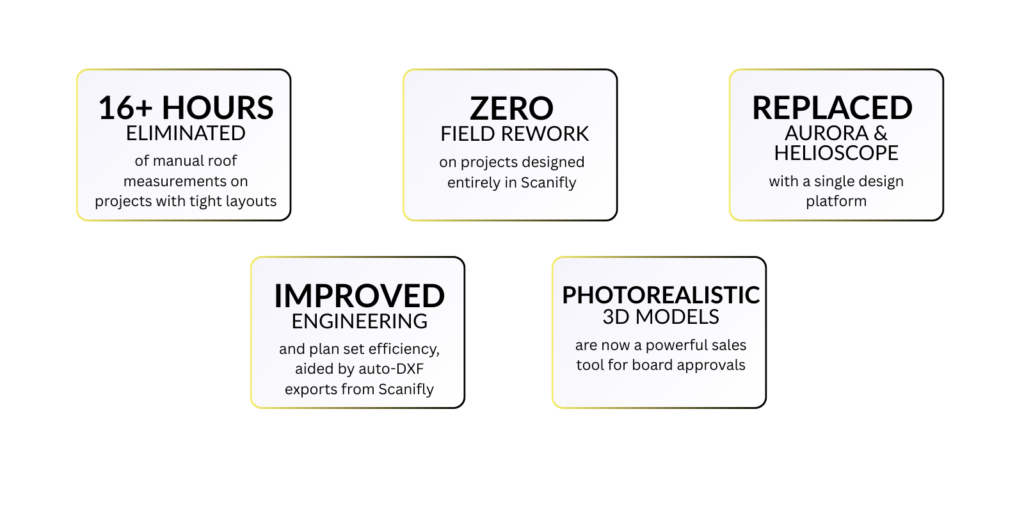
Results From Using Scanifly
Company Overview
EightTwenty is an Oklahoma City-based commercial solar EPC, but that wasn’t always the case. The company started in residential solar, building a strong reputation for quality. That foundation enabled a successful shift to commercial work in 2022, where they found even greater success and where they now focus almost exclusively.
EightTwenty’s move into commercial work also opened doors to a unique client base: nonprofit organizations. Schools, food banks, and homeless shelters were genuinely excited about solar’s potential to reduce their rising energy costs. The problem was the upfront investment, even considering direct-pay benefits. After designing dozens of proposals, EightTwenty managed to close just one out of 50 initial nonprofit project proposals.
Then a board member at one project asked a simple question: What if I invest in the project and take the tax credits that the nonprofit can’t use?
That question sparked 18 months of due diligence, ultimately leading to the launch of Brightwell, a new financing platform that connects community organizations and nonprofits with impact investors who have significant tax liabilities.
“A business can have rising energy prices and just pass those costs on to customers,” explains Evan DeWalt, SVP of Marketing at Brightwell. “Nonprofits have to absorb them. Their option when energy prices go up is basically to reduce headcount or reduce services.”
Today, EightTwenty handles design-build and installation work across Oklahoma. Through Brightwell, they partner with installers nationwide, including fellow Amicus Solar Cooperative members such as Denver-based Namaste Solar, where they are collaborating on projects like the $3 million Food Bank of the Rockies installation.
“Most of our team didn’t come from solar, so we approached this model differently than the rest of the industry,” DeWalt notes. “I think that’s what’s helped make us exceptional in this space.”
But whether building locally or managing projects across the country, the model depends on one thing: accurate designs that maximize utility bill cost savings.
The Challenge: When Expensive Tools Create Inefficient Workflows
For years, EightTwenty relied on the standard commercial solar design stack: Aurora for preliminary designs and Helioscope for detailed engineering work.
Then Aurora’s prices skyrocketed.
“Aurora told us they were going to jack up prices to insane levels,” recalls Matt Brodine, VP of Design Operations at EightTwenty. “That got us started thinking, okay, we’re done with Aurora, we’re done with Helioscope. We’ve got to find something else.”
But cost wasn’t the only problem. The fragmented workflow created serious inefficiencies:
Manual Measurements Were a Blocker
Before finalizing designs, field teams spent hours on rooftops with tape measures trying to capture precise dimensions and identify obstructions.
“I had projects where field teams would send me a hundred photos of a guy standing with a tape measure,” Brodine explains. “And then it would take me hours to translate that. Where was he standing? Where was he looking? Where was that tape measure running? It was really difficult.”
Even after all that work, the measurements often didn’t line up. Build teams would arrive on site and have to rearrange the entire array because the interpreted measurements were still off.
Disconnected Tools, Duplicate Work
EightTwenty was outsourcing their construction drawings and electrical stamping. Moving designs from Helioscope to AutoCAD meant recreating work, with plenty of room for errors and miscommunication.
The team searched for alternatives, but the options were all too early-stage and buggy. They looked at Scanifly in early 2024, but at the time, the platform only offered drone-based design.
“We do lots of quick models for free up front before we sell deals,” Brodine notes. “We can’t afford to drone every single one of them.”
Scanifly’s combination of unlimited remote data and design tools for sales, paired with drone-based 3D models for operations and engineering, was the perfect fit for their business model.

The Solution: One Platform, From Lead to Installation
The breakthrough came at a NABCEP conference when EightTwenty reconnected with the Scanifly team and learned about the new PrelimDesign tool—satellite imagery-based designs for sales that complemented Scanifly’s DroneDesign product.
“That’s when we realized you now have a nice cradle-to-grave ecosystem,” Brodine explains. “The remote design upfront, where we can do quick designs based on satellite imagery, and then the drone design when we sell a project, and then continuing on to aid our permit and construction drawings.”
The integrated platform solved EightTwenty’s core challenges:
Affordable Preliminary Designs at Scale
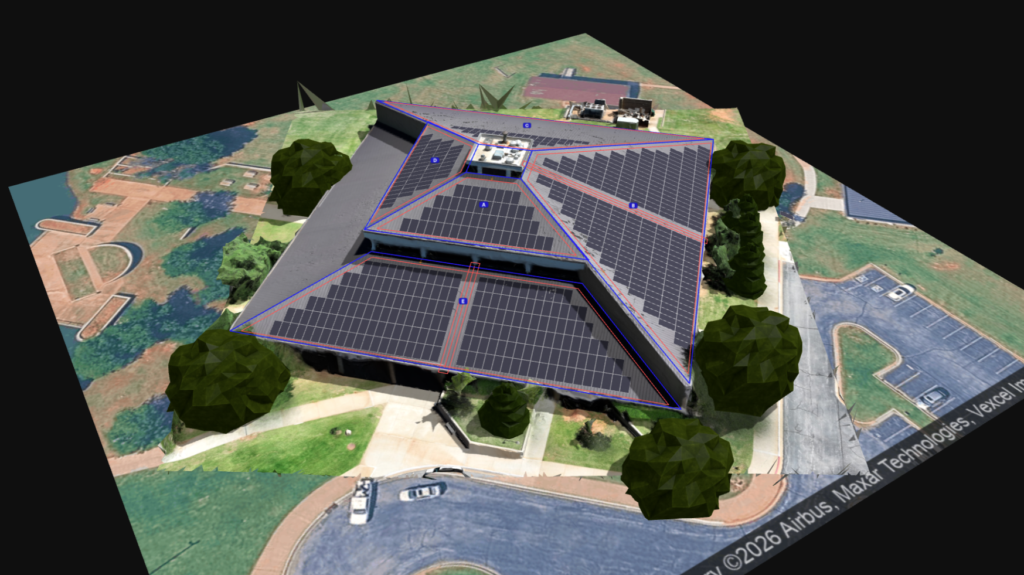
With Scanifly PrelimDesign, EightTwenty can create preliminary layouts using satellite or aerial imagery, which is perfect for nonprofit prospects evaluating solar feasibility without the cost of a drone flight for every lead.
Inch-Accurate Drone Models
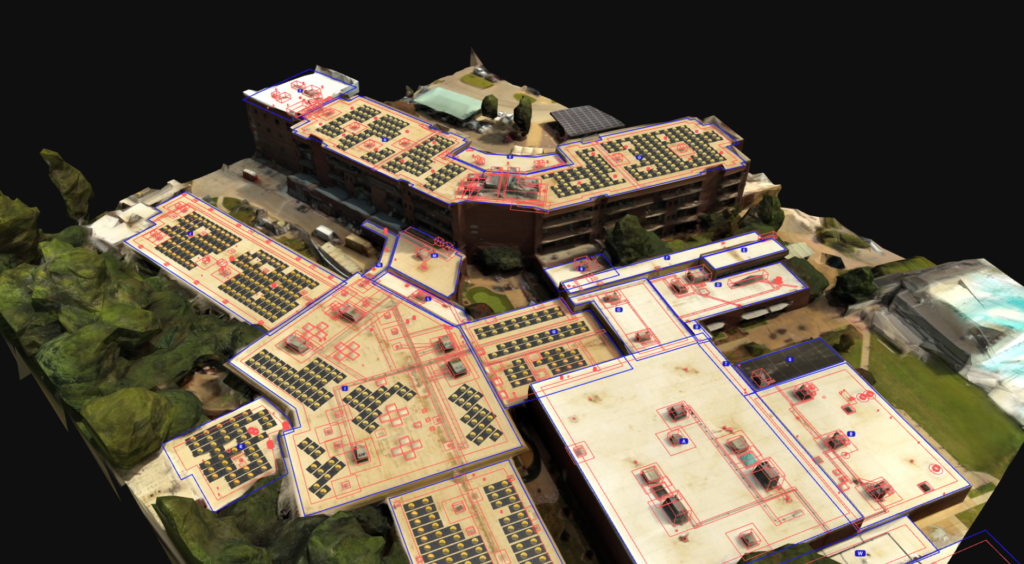
Once a project is sold, EightTwenty’s field team conducts technical site inspections. The drone operator captures comprehensive roof and property data while the electrical team focuses purely on their specialty.
“We’ve been able to split that and dial in our expertise a little bit,” Brodine explains. “The guys who do the electrical site inspections really are electrical guys. They never were roof-measurement guys.”
And the resulting 3D models provide the precision that eliminates any guesswork.
Automated Design to AutoCAD Workflow
EightTwenty recently brought plan set drafting and structural stamping in-house. Scanifly’s automatic DXF file exports flow directly into AutoCAD, maintaining accuracy throughout the design-to-build process.
“We just delivered our first full in-house plan set with the Scanifly model being used, and our build team loved it because we could easily add all the features they wanted into the plans,” Brodine reports.
The Impact: Faster, More Accurate Solar for Organizations That Need It Most
For EightTwenty and Brightwell, Scanifly’s platform isn’t just about operational efficiency; it’s fundamental to their mission of providing the responsible, advanced stewardship of the sun’s power to lift up our communities for generations to come.
Homeless shelters with massive HVAC bills. Food banks serving entire regions. Schools trying to invest in students rather than rising utility costs. These are the organizations where solar makes the biggest difference.
“The promise that distributed energy generation should have is how do we get it into places of need where the cost of energy is forced?” DeWalt explains.
The ability to capture accurate site data and generate photorealistic 3D models means EightTwenty and Brightwell can deploy more solar power, faster, while maintaining the quality standards that define their work.
“There are real dollars being saved throughout many steps of our process, especially after our sale. Engineering, drawings, everything,” Brodine notes.
The platform enables EightTwenty and Brightwell to deliver on their unique value proposition: bringing solar to the organizations that benefit from it most, designed with precision, built with quality, and financed in a way that actually works.
About EightTwenty
EightTwenty is an Oklahoma City-based commercial solar EPC serving clients across their regional service area with design-build expertise and in-house installation capabilities. Through their Brightwell financing platform, they’re expanding access to solar nationwide by connecting nonprofits with tax equity investors, partnering with quality installers to deliver projects that maximize utility savings for schools, food banks, homeless shelters, places of worship, and other mission-driven organizations.