
Customer Story
Interconnect Electric Reduces Install Timelines by 6 Days & Eliminates Change Orders with Scanifly + Pipe Software Stack

Results From Using Scanifly
Meet Interconnect Electric
In the ultra-competitive DC, Maryland, Virginia, and Pennsylvania solar markets, Interconnect Electric has built its reputation on a simple but uncommon philosophy: quality first, then speed.
“It’s quality and then speed,” explains Stan Swoyer, Managing Director at Interconnect Electric. “Because with the quality comes the aesthetics. People are seeing our work, and they’re experiencing it. You can overcome some delays. But the quality aspect of it, if you’re not focused on that from day one, in my opinion, you’re going to fail.”
Founded in 2014 by partners who had worked together across the industry for nearly two decades, Interconnect Electric serves residential and small commercial customers throughout the DMV region and the newly added PA market. The team also handles significant EV charger installations, positioning themselves as a comprehensive home electrification partner rather than a single-service provider.
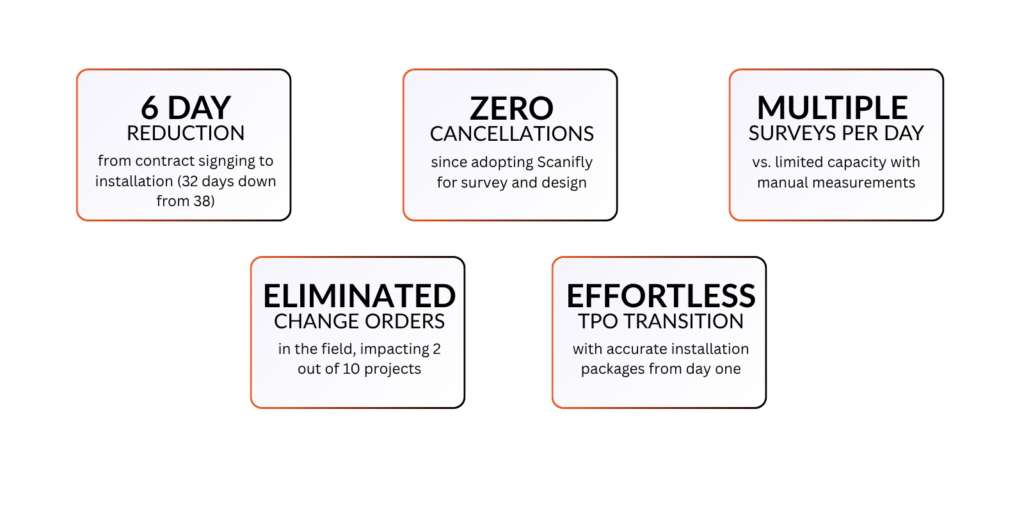
Their approach has created a powerful differentiator in a crowded market: an average timeline of just 32 days from contract signing to solar installation—2X faster than the industry standard—while maintaining exceptional quality standards.
This combination of speed and precision keeps both customers and sales partners exceptionally satisfied, driving steady growth through a competitive landscape where contractors are constantly vying for homeowner attention.
The Challenge: Fragmented Tools and Inconsistent Data Across Multiple Sales Teams
Despite their success, Interconnect Electric faced operational challenges that threatened their efficiency goals, particularly as the industry shifted following the ITC expiration.
Multiple Design Platforms Creating Data Chaos
Interconnect worked with several external sales organizations, as well as its own internal team, each using different design tools: Aurora, Solargraf, and others.
“When you were working with multiple sales organizations, including internal sales, and you have data coming at you from three or four different streams, you’re now wasting resources to mold all those different sources of data into something usable that is consistent,” Swoyer explains.
This fragmentation meant engineers had to spend significant time reconciling designs from different platforms, each with potentially different satellite imagery ages and design assumptions.
Time-Consuming, Dangerous Manual Surveys
Before Scanifly, site surveys required rolling a truck with ladders and having a technician spend hours on rooftops with tape measures.
“Within a week of contract signing, we’d have a technician on site taking pictures on their phone, pulling tape, and climbing on the roof,” Swoyer recalls.
The team briefly explored having salespeople conduct a portion of the traditional surveys during their initial visits, but the approach failed. Sales reps were either reluctant to shift gears from closing mode to technical surveying or rushed through measurements to get to their next appointment, resulting in poor data quality.
Looking back, Swoyer sees how drones completely change that equation: “If I knew what I know now, and let’s say I was just solely on the sales side of it, I’d be flying that drone as part of my sales process and sharing the 3D model at that time. I think that would be really, really impactful.”
Manual measurements also posed serious safety concerns and weather limitations that could lead to full cancellations rather than just rescheduling the drone portion of a visit.
TPO Transition Amplifies Every Inefficiency
The July 4th reconciliation bill and the expiration of the ITC forced a dramatic shift from cash-and-loan sales to third-party ownership (TPO) models. Interconnect Electric recognized this change would make every inefficiency more painful.
“The moment production changes by the slightest amount, you run the risk of price changes. You run the risk of the project not moving forward at all,” Swoyer explains. “If you only change the orientation of a panel, not even the plane that it’s on, you’re doing a change order on plan sets to avoid being rejected in the installation package because it doesn’t match exactly.”
Change orders that occurred in roughly 2 out of 10 projects under the ownership model became completely unacceptable in the TPO environment.
The Solution: Integrated Sales & Design Platform with Drone-based Precision
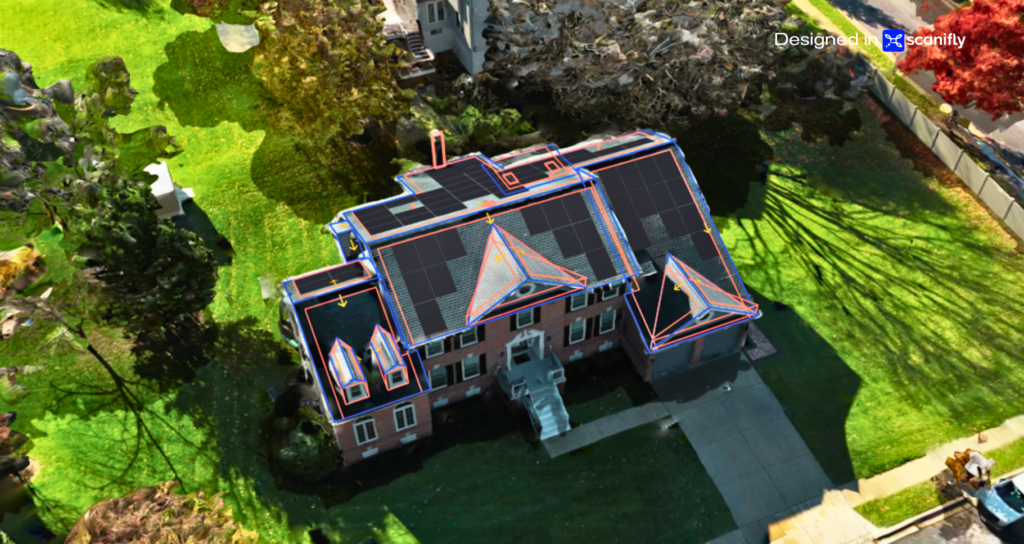
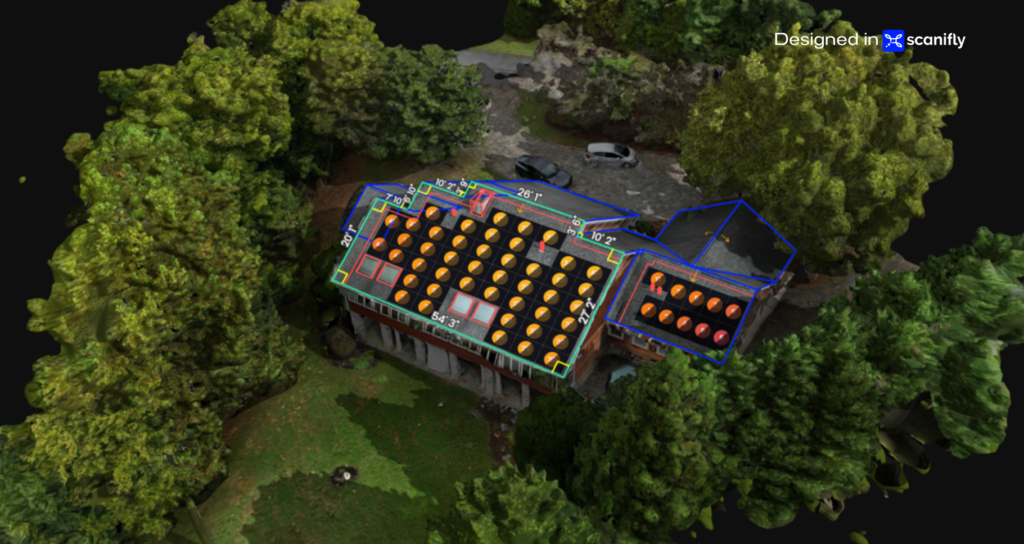
Interconnect Electric’s transformation came through the strategic integration of Scanifly’s drone-based surveys and embedded design tools within the Pipe proposal platform, creating a unified workflow from first customer contact through final installation.
Consistent Data from Day One
By bringing all sales partners onto Pipe’s point-of-sale software, powered by Scanifly’s remote design tools, Interconnect eliminated the data fragmentation that had plagued their operations.
“By bringing in Pipe and Scanifly simultaneously, our data is consistent from the front end of the project to install day,” Swoyer says. “That consistency has allowed us to trim time and increase the quality of the initial design process.”
Sales partners immediately recognized the benefit. “Some even dropped their Aurora subscriptions after seeing the streamlined workflow because it helps with their efficiency as well… now it’s a direct cost savings to them,” Swoyer explained.
Safer, More Efficient Drone Surveys
Instead of spending hours on dangerous rooftops, Interconnect’s survey team now captures comprehensive site data with drone flights while focusing on electrical and structural assessment work that requires their expertise.
“When you can send someone out in a car versus a truck with ladders, that’s a big difference,” Swoyer notes. “There’s efficiency there, there’s cost savings there, there’s different personnel you can now bring into the fold.”
The time savings from eliminating rooftop measurements have also dramatically increased survey capacity. “Now we’re doing multiple in a day where we weren’t able to do so in the past.”
TPO Success From the First Flight
The accuracy proved critical during Interconnect’s first TPO project, and fortunately, it was completed during their Scanifly trial period.
“We had a project that was one of our very first or second TPO projects. It was the first flight that we did with you,” Swoyer recalls. “We found three errors from obstructions and AHJ setbacks that would have required an in-field change order.”
The drone data caught these issues before they reached the field. “We were able to solve that and have the installation go the way it was supposed to originally, and it was flawless. I’m so thankful we didn’t come out of the gate with a new TPO partner and say, ‘we’re just like everyone else.’ Now, here’s our first project. Here’s a change order.”
The Impact: Quality, Speed, and Zero Cancellations
The integrated sales, survey, and design workflow delivered measurable improvements across Interconnect Electric’s operations while maintaining their uncompromising quality standards.
Six Days Faster from Contract to Installation
“We’ve saved six days on average off of our installation timelines,” Swoyer reports. The average timeline dropped from 38 days to 32 days, with some projects completing in as little as 17 days.
This speed matters. “Our goal as a company is to shave days off our average time from contract signing to install,” Swoyer explains. Faster timelines reduce cancellation risk and accelerate cash flow for both Interconnect and their sales partners.
Zero Cancellations
Since implementing Scanifly, Interconnect has seen zero project cancellations—a remarkable achievement in an industry where extended timelines often lead to buyer’s remorse.
“Since this adoption, we’ve seen zero cancellations,” Swoyer states. “I believe that we’ve really improved the customer experience with the adoption of the tool as well.”
Change Orders Eliminated
2 of the 10 projects that previously required change orders have been eliminated due to the accuracy of Scanifly’s 3D models.
“We’ve cut out revisions on plan sets significantly,” Swoyer notes, referring to the engineering review process that now works from consistently accurate drone data.
Enhanced Customer Experience
The drone flights themselves have become a differentiator in customer interactions.
“When customers see us flying a drone around their house, it builds rapport. They ask for that footage,” Swoyer explains. “It adds another level of customer interaction and instills confidence. You actually look like a tech company!”
Sharing the 3D models creates unprecedented transparency. “They’re blown away by it,” Swoyer says. “They can see we’re taking extra steps that their neighbors’ installers didn’t.”
Opening New Job Opportunities
Additionally, the shift away from dangerous rooftop work has opened survey roles to a broader range of employees.
“Proper safety training for traditional surveys is extremely time-consuming, costly, and so important. But we’ve eliminated those costs, and we’ve eliminated having to have someone carry around a 30-foot ladder for every site visit,” Swoyer says.
About Interconnect Electric
Interconnect Electric is a DC-based solar installer serving residential and small commercial customers in Maryland, Virginia, and Pennsylvania, with design-build expertise and integrated installation capabilities. With an industry-leading 32-day average timeline from contract to install, the company has built its reputation on quality-first execution and comprehensive home electrification services, including solar, battery storage, and EV charging solutions.