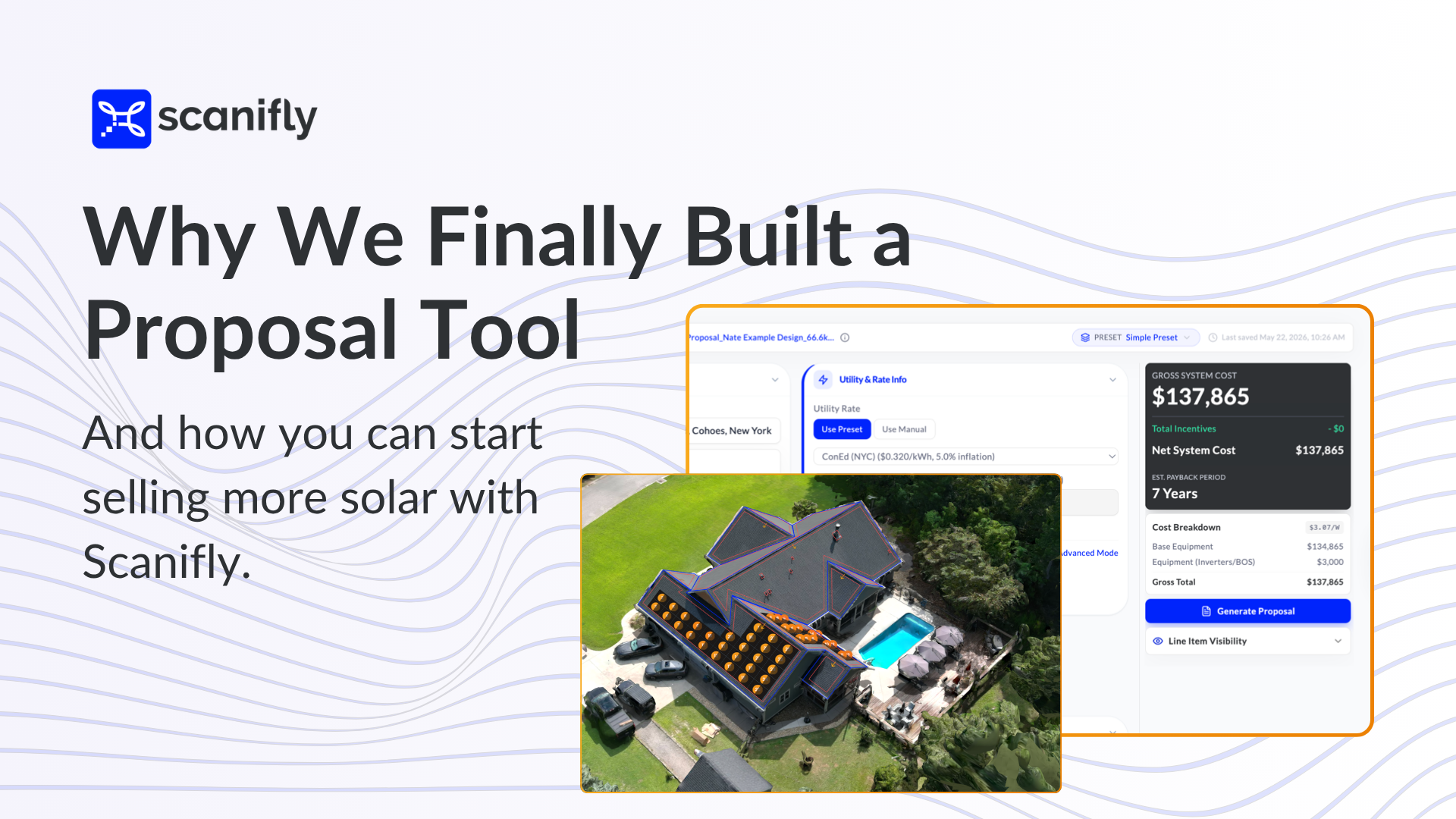
Scanifly built its reputation on drone-based design and field operations. Here’s why we resisted building a solar proposal tool for years, what changed our minds, and what it means for solar contractors looking for a better workflow.
Where We Started: Design and Field Ops
Some old Scanifly lore: when the company launched in 2017, the platform included a mobile drone-flying app and a LiDAR 3D scanner nicknamed “Flydar” that mounted directly on a drone. Hardware, software, and field data capture all under one roof. A couple of years in, Scanifly narrowed its focus entirely to drone-based solar design software, and that decision defined everything that came after.
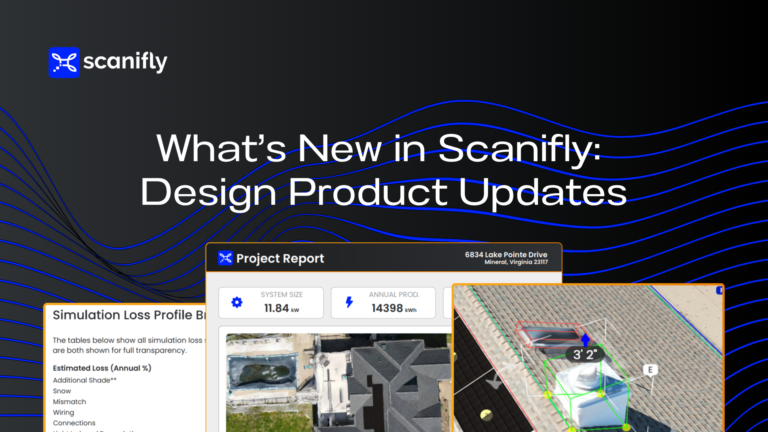
From there, the team doubled down on building technically complex, feature-rich tools for solar contractors. That meant the drone-based photogrammetry and computer vision environment that produces photorealistic 3D models of a home and its surroundings, a field ops mobile app that replaced the need for tools like CompanyCam and Site Capture, and robust racking integrations that connected design data directly to manufacturers and procurement.
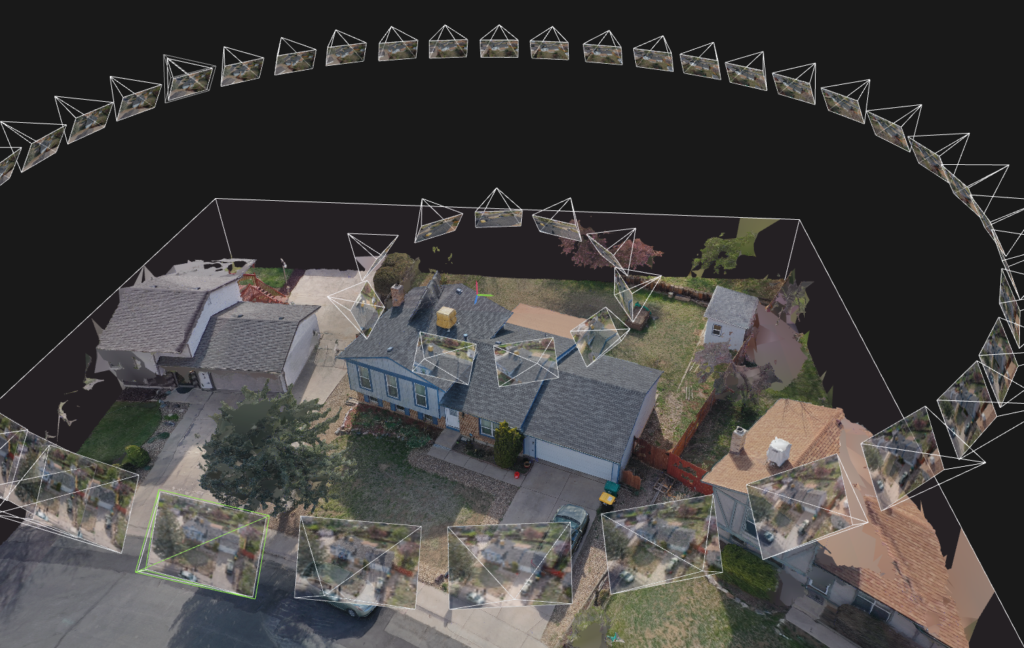
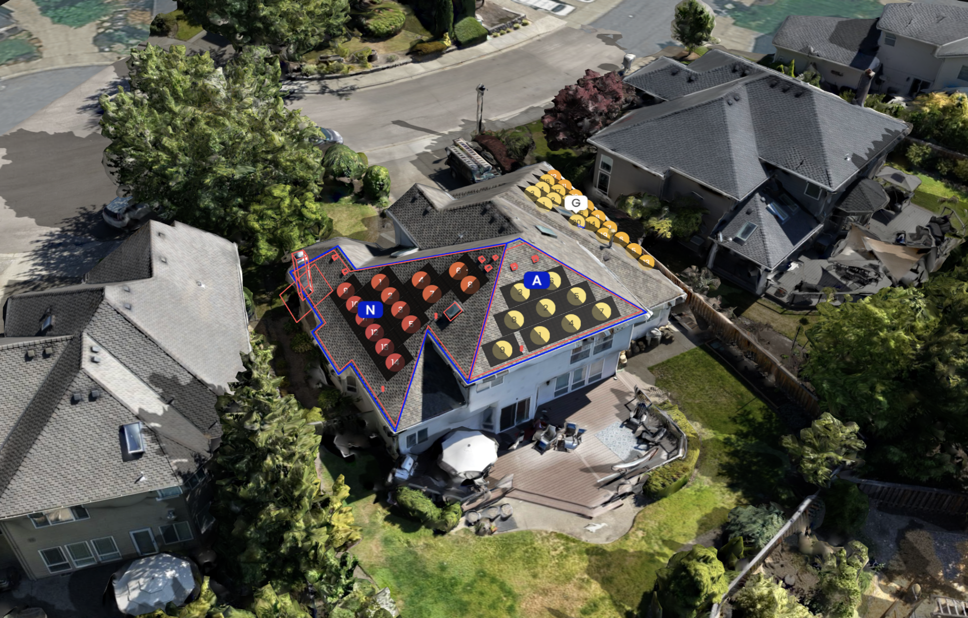
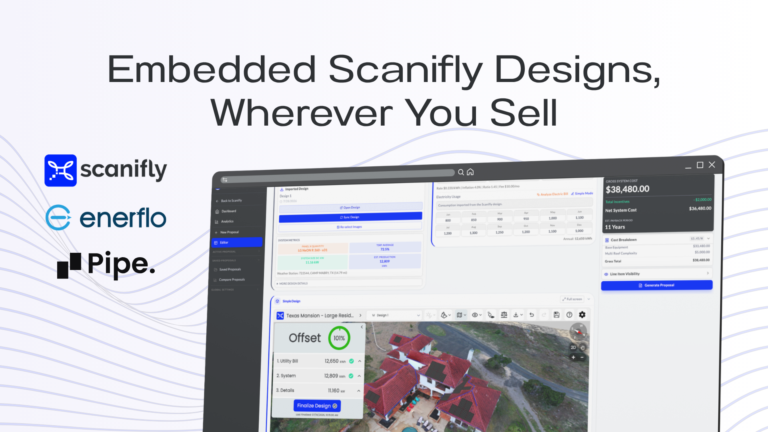
Starting in 2023, Scanifly brought that same technical foundation to sales reps with the launch of PrelimDesign, a remote sales design tool built on the same platform. For everything in between, from financing to proposals to project management, Scanifly leaned on its integration partners: Enerflo, Pipe Solar, SubcontractorHub, Energy Toolbase, SunRaise, and others.



Going into 2025, solar proposals still felt like a departure from that focus. But the market continued to shift, and we decided to follow.
How Our Hypotheses Changed
The solar proposal space was crowded and commoditized, with over $700 million in venture capital flowing into solar sales software, most of it to Aurora. Dozens of tools existed, and most contractors already had some version of a proposal workflow, whether through a middleware platform, their own spreadsheets, or one of the many off-the-shelf options on the market. Building new software in that landscape didn’t make sense for us at the time.
But the more we spoke with our customers and learned that the majority were still searching for a better proposal experience and output, the harder it became to ignore this opportunity.
Three things shifted our thinking:
- The ubiquity of off-the-shelf proposal tools. Despite how homogenous those tools were, most contractors preferred them over maintaining their own spreadsheets or exports. They wanted something prebuilt, even if it wasn’t perfect
- Contractors are consolidating their software stacks. Given the market challenges of the last three years, companies wanted fewer tools. One simple workflow. Not three platforms stitched together.
- Scanifly was still just one part of the workflow. Despite expanding upstream by offering sales design tools and integrating with strong partners, we remained part of the process. If we couldn’t help contractors get their data out of Scanifly — a document at minimum — many would relegate us to an ancillary tool.
The Reasons We Built Our Own Solar Proposal Tool
1. Customers asked for a solar proposal tool, consistently and clearly.
The feedback wasn’t subtle. Contractors across all market segments told us they weren’t happy with the proposal tools available to them. The complaints ranged from price to lack of customization, templates that all looked the same, and features they didn’t need bundled with those they did. They didn’t understand what they were paying for with clunky, fractional credit systems either.
We’ve always had a running joke internally that most homeowners receive the same Aurora or Solo proposal regardless of which contractor sold them. We always respected the contractors who built their own tools because it helped them stand out. But not everyone has a marketing team or the bandwidth to do that. Customers wanted more from their presentation materials, and they wanted it to come from us.
2. Our integration partners are great, but they don’t do everything.
Scanifly integrates directly with Enerflo, Pipe Solar, SubcontractorHub, Energy Toolbase, SunRaise, and others. We love these partners, and they have powerful platforms, particularly for contractors with complex sales operations, multiple financial products, sales org management, CRM needs, and project management workflows. For those use cases, the “middleware” model works well.
But for a large segment of our customer base, combining Scanifly with a middleware platform is overkill. Local contractors with W2 sales reps, few or no financial products, and a more consultative sales process – often known as “the long tail” don’t need that infrastructure. Pushing those customers toward a middleware they don’t actually need was costing them money and adding complexity they didn’t want.
3. The market has split into two distinct sales motions.
The One Big Beautiful Bill accelerated a pattern that was already underway. Solar contractors are increasingly choosing one of two identities.
- The Dealer/EPC model, which typically requires a sales operations tool, access to multiple financial products, and the full infrastructure of a sales operations platform.
- And the consultative sales model, which is made up of W2 reps, few or no financial products, and a need for a simple proposal export. These contractors are cost-conscious and typically have their own CRMs to manage the sales process.
4. We needed a way to get data out of Scanifly.
Prior to building a proposal tool, contractors could only share screenshots and a one-pager of a 3D design and shading analysis. There was no way to export project layouts, shade data, and economics into a single presentation. We had nothing for sales reps to really sell with.
That’s a problem. No matter how good the imagery is inside Scanifly, and it’s excellent, contractors still need to put a complete proposal in front of a homeowner. We weren’t providing that, and it was limiting how much value customers could extract from everything else we’d built.
5. We identified the unlock for more Selling with Drones.
Over the last few years, more contractors have been flying drones earlier in the sales process, and the data tells a pretty consistent story. Contractors selling with drones have seen sit rates climb by more than 75%, along with improvements in pull-through and close rates, and a near-elimination of cancellations and install-day change orders.
The emotional side is harder to quantify but just as important. As one customer put it, “Homeowners stop doubting the numbers once they see their own home in 3D.” When a homeowner can see exactly what their system will look like, where the shading comes from, and that the design was built from data captured at their actual property, it changes how they evaluate the proposal. That level of precision and quality builds trust and confidence in a way that satellite imagery-based designs cannot.
Those same contractors have also been asking for a Scanifly proposal tool. Some included the Share Link in their custom proposals as a workaround, a one-pager with system info and a 3D model that gives homeowners something visual to reference. It is a valuable tool, but the demand for a native proposal solution kept growing.
Over the past year, teams at Lighthouse Solar, Green Mountain Solar and Granite State Solar, Interconnect Electric, Infinity Solar USA, Freedom Solar, and dozens of others nationwide have made it clear that a proposal is the missing piece.
So What Are We Building: Not JUST a Solar Proposal Tool
As you likely gathered from this blog, Scanifly now has a proposal tool in development. It’s actively being iterated on, and it’s priced as part of a single platform subscription that includes sales design, proposals, field operations, drone capture, plan sets, CAD files, and racking integrations – everything in one!
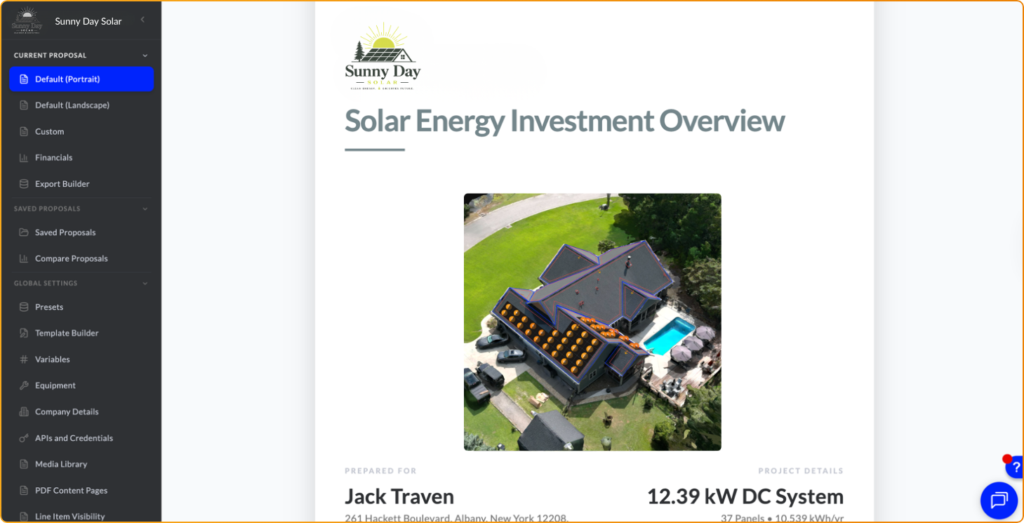

As of now, we’re not building a CRM. We’re not building a financing origination portal. We’re not trying to replicate the sales operations platforms our partners have built. For contractors who need those tools, those integrations remain in place, and we’re continuing to invest in and strongly advocate for them.
Honestly, Scanifly Tried to Avoid This
Before we pursued our current solution, we tried several other approaches. We built Google Slides macros, explored PandaDoc integrations, and leaned into every partnership we could to give customers a path that didn’t require us to build this ourselves. We wanted to focus on building excellent design and field ops tools and on integrating or partnering on the rest. However, none of it ultimately got us to the desired sales workflow for many of our customers.
Initially, we didn’t want to build a proposal tool, but we’re glad we did.
If you’re interested in access or a demo, don’t hesitate to reach out to our team. We’re excited to bring the next innovation to the solar industry, and plan to keep doing that for years to come.
Frequently Asked Questions
What is Scanifly Proposals, and who is it for?
Scanifly Proposals is a solar sales proposal builder included with the Scanifly platform subscription. It’s designed for solar contractors who want a professional, customizable proposal output without paying for a separate middleware platform. It works particularly well for local and regional contractors with W2 sales reps and simpler financial product offerings.
How does Scanifly compare to Aurora Solar for proposals?
Scanifly Proposals is priced as part of a single platform subscription that includes drone-based design, field operations, plan sets, and more. Aurora is primarily a remote design and proposal platform without native drone data capture, drone-based 3D modeling, or field operations capabilities. For contractors seeking an all-in-one workflow built on accurate site data, Scanifly offers a more comprehensive solution.
Does Scanifly replace middleware platforms like Enerflo or Pipe Solar?
Almost always no. Enerflo, Pipe Solar, and similar platforms are strong tools, especially for contractors with complex or external sales operations, multiple financial products, and a need for fully embedded tooling. For those use cases, those integrations remain in place, and we’re continuing to invest in and improve them. For contractors with simpler operations who don’t need that infrastructure, Scanifly Proposals provides everything they need in one platform.
Can I still use Scanifly with my existing CRM?
Yes. Scanifly integrates with major CRMs and is not looking to replace them. The goal is to give solar contractors the most complete sales, design, and operations workflow available, not to replicate the broader software stack they already use.
What makes Scanifly’s workflow different from other solar design software?
Scanifly is the only solar design platform built natively around drone capture and photogrammetry. Designs start with inch-accurate, current site data rather than outdated remote imagery, which produces more accurate layouts, more reliable production estimates, and fewer install-day surprises. The addition of a proposal tool means that accuracy now flows all the way through to the homeowner presentation.