Enerflo and Scanifly walk through new data on how many signed solar deals actually get installed, and what contractors can do to get more of them to the finish line.
Every solar company knows its close rate. Ask about pull-through rate, the share of signed contracts that become installed systems, and most will say “around 60%.” Enerflo reviewed several years of platform data across several hundred installers to confirm. The answer was 41%.
On October 1 we hosted Beyond the Sale: Fix Solar’s Fulfillment Problem with Pat Bennett (Co-Founder & CEO, Enerflo) and Jason Steinberg (CEO, Scanifly), moderated by Brad Knudsen (Head of Marketing, Scanifly).
Measure your pull-through rate, not just your close rate
Enerflo’s data shows that only 41% of signed contracts were installed within six months. Pat’s method: anything not installed by day 180 counts as lost. Then break it down by sales dealer, by market, and by lender. Jason ran the math live: on 100,000 signed deals, 59,000 never finish. At $5,000 a rep commission, that’s $295 million in missed commissions, with a comparable number on the EPC revenue side.
Install by day 90
Of every signed deal Enerflo tracked, 32.7% were installed by day 90 and 41.6% by day 180. After that, almost nothing gets installed. Pat’s rule: “If you want an install to happen, do it by day 90.” Permitting queues are out of your hands, so compress what you control. Jason’s point: with drone data and a mobile app capturing the site, a contractor can be permit-ready two days after signature.
Learn from the installers who keep twice the deals
Among installers with at least 200 settled deals, top performers reach the 70s, while the bottom sits in the 20s. In-house sales teams average 48.5% against the 41.6% overall average, but some EPCs selling only through outside dealers are above 50% too. Control over the process raises the ceiling, and an EPC can enforce that process with dealers.
Kill the avoidable change orders
Projects that needed a re-signed contract averaged 86 days from signature to install. Projects signed once averaged 75. A change order costs about 10 days, and that’s only among installed deals. Re-sign rates run as high as 28% at some installers and under 5% at others. Pat’s take: “There are enough tools and checks and balances in place where if you do this right, you do not need to have change orders.”
Communicate the good change orders upfront
Jason pushed back: why is the industry so afraid of change orders? Trees grow. Sometimes the survey finds a better roof plane for the homeowner. Pat’s answer is that the problem is the surprise. Tell the homeowner at the first sit that you’ll run checks over the next few days and may come back with an adjustment that’s better for them. Then the change is part of the process instead of a bait and switch.
Hold your sales orgs accountable
Jason’s hot take: cut the bottom 10% of dealers by fulfillment rate, regardless of signed contracts. Chasing volume from orgs with bad fulfillment hurts operations, reputation, and the industry. Pat’s softer version: run QBRs with dealers on their pull-through numbers, and pay a bonus for a perfect packet with no change order. The money to fund it is already in the deals you stop losing.
Use AI designs to start the conversation, and a drone to close it
About 25% of projects have an install-day revision, most often a panel that didn’t fit. Jason lays out three design phases: generate leads with fast AI estimates, start the sales conversation with satellite- or aerial-imagery-based designs, and ensure perfect install-day fitment with a drone-based 3D model. Contractors moving the drone up-funnel are seeing positive results: roughly 20% higher close rates; one EPC added a drone step between the knock and the sit and grew revenue 124%; and groups using drones while door knocking saw a 70% increase in sit-rate.
Fix contracts and documents at the kitchen table
Pat walked through what’s already in Enerflo to stop change orders before they start: title checks so the right person signs the first time, AI utility bill checks that flag a blurry or outdated bill at upload, rules-based contract packets so every required agreement is signed properly, and a project submission gate that shows the rep what’s missing while they’re still in the home.
Keep the homeowner in the loop
A homeowner who hears nothing for three weeks starts wondering if you’re still in business. Enerflo’s customer portal (the “solar pizza tracker”) shows each milestone, and the best installers add short videos explaining what happens next and how long it takes. It’s also where referrals come from later.
Fix the slow season now
Capital is tight and deal flow is down for a lot of contractors. Pat’s argument is that this is the time to fix intake, contracting, and survey processes, so the operation is ready when volume comes back in the new year.
Watch the full webinar
Chapters:
0:00 Why fulfillment is solar’s real problem
17:06 Only 41% of signed deals get installed
22:38 Most installs happen by day 90
28:11 Top installers keep almost twice the deals
33:38 A change order costs about 10 days
38:04 Are all change orders bad?
42:24 In-house vs. EPC vs. hybrid
46:14 Design data and where AI designs fit
49:38 What contractors can do today
51:16 Enerflo features that prevent change orders
Get Scanifly and Enerflo working together
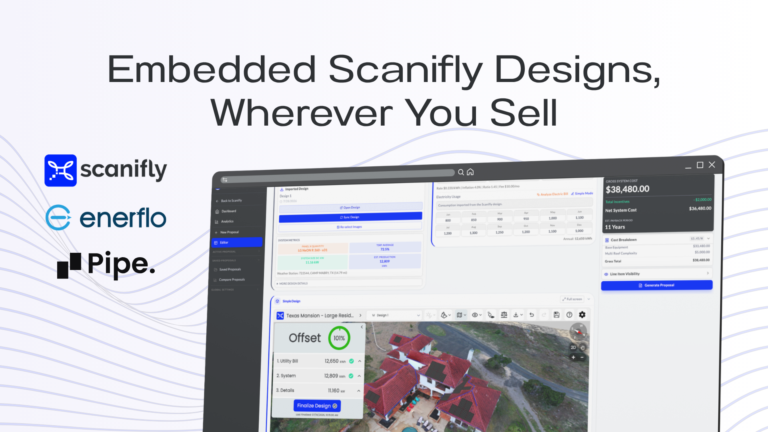
Scanifly’s design tools are embedded directly in Enerflo, so a rep can order a design, run a proposal, and submit a clean project without leaving the platform. If you want to see how the two platforms get a signed deal to install day, book a demo or read about the Enerflo integration.